Not a contractor. Lead referral platform covering Portland's 10 deepest cost markets.
WHAT FLAT ROOFING ACTUALLY COSTS IN PORTLAND
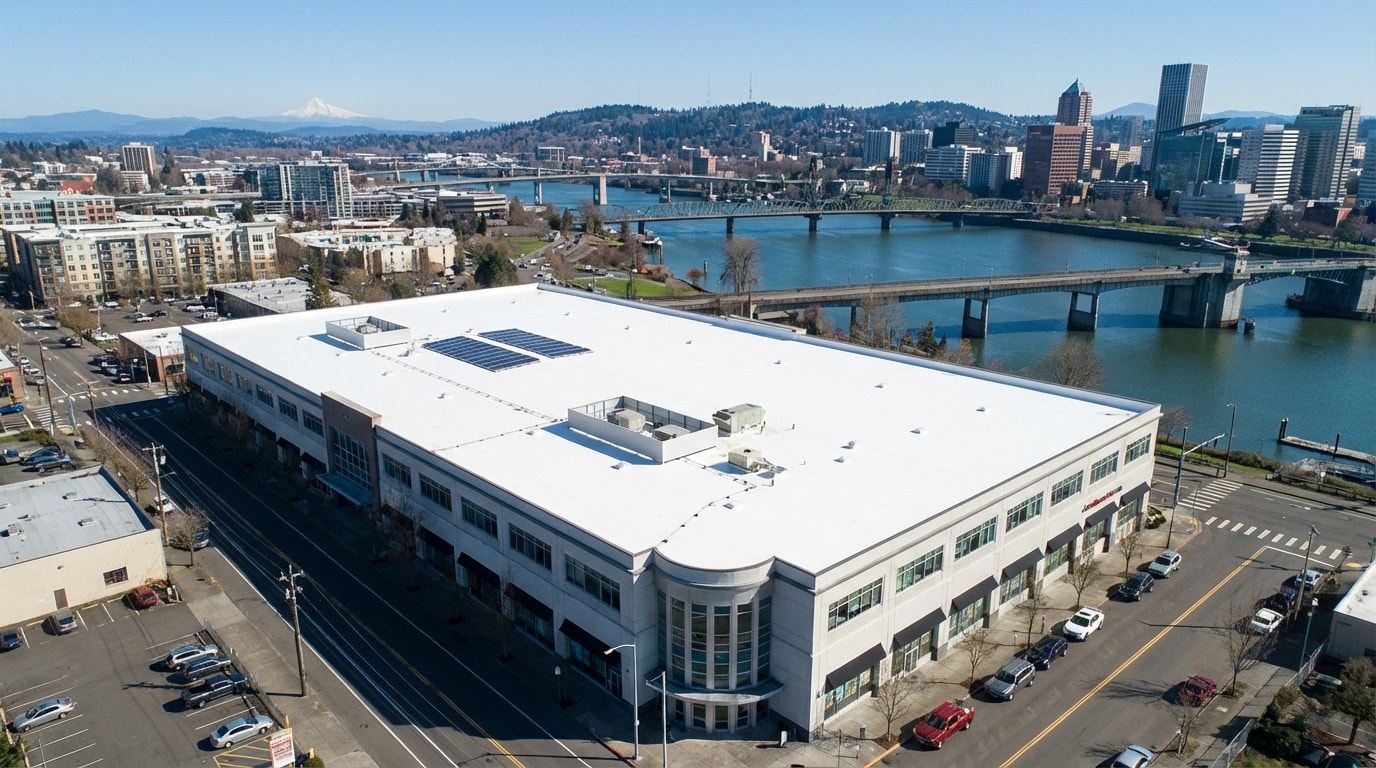
Portland flat roofing economics differ fundamentally from pitched-roof economics. The dominant Portland flat roof market is the Pearl District residential tower / townhouse complex, converted brick warehouses, mid-2000s residential builds, and 2010s townhouse projects with TPO membrane systems on 18–22 year replacement cycles. A typical Pearl townhouse replacement runs $30,000–$55,000; the same property with pitched architectural would run $14,000–$18,000 if it could accept that geometry (most can't).
The variable that distinguishes durable flat-roof installations from problem installations is drainage discipline. Portland's 144 rain days mean every drainage compromise compounds, a 1/8-inch slope deficit that would never matter in Phoenix produces ponding water within 48 hours of any rain event in Portland. Membrane systems on poorly-draining roofs fail at seams, blisters, and parapet transitions within 8-12 years vs. the 20-25 advertised. Drainage rebuild during membrane replacement is essential, not optional, addressing it after the fact requires reopening completed membrane work.
60-mil TPO with heat-welded seams is the practical Portland residential flat-roof standard. 45-mil TPO with adhesive seams was common in 1990s-2000s installations and is now reaching end of life, that vintage drives the active Pearl replacement market. The premium for 60-mil over 45-mil ($2,000-$4,000 on typical residential project) is recovered within 5-8 years through reduced seam-failure risk. Heat-welded seams are non-negotiable; adhesive seams in Portland's wet climate fail at parapet transitions and high-traffic areas within 10-12 years.
Annual September inspection ($150-$300) before the wet season begins is the single most cost-effective flat-roof maintenance practice in Portland. The inspection catches drain blockages, parapet flashing degradation, seam stress, and minor membrane damage at a stage where repair runs $300-$1,200. The same problems caught after the wet season through interior water damage run $8,000-$20,000 including drywall, insulation, and finishes. Most Portland flat-roof failures aren't sudden, they're slow leaks that accumulate damage for 6-18 months before becoming visible.
In Portland, flat roofs require correct drainage slope, minimum 1/4 inch per foot to drains. A roof that pools standing water 48 hours after rain is failing. Address drainage as part of any membrane replacement, not after.
WHAT MOVES FLAT ROOFING QUOTES
The factors that move flat roof & tpo quotes most in Portland, with quantified impact and the explanation behind each. Use these to evaluate whether a contractor's bid reflects local conditions or is missing something.
Residential towers, mid-2000s townhouse complexes, converted warehouses. Per-unit cost split varies; full complex projects benefit from coordinated crane and review.
Internal drains, scuppers, slope correction. Essential during membrane replacement; addressing after creates membrane disruption.
Converted brick warehouse projects (NW 11th, NW Glisan corridor) often need parapet flashing rebuilt. Original detail decades old.
Standard PDX spec. Heat-welded seams required regardless of gauge. 45-mil is acceptable on small protected residential applications only.
Pearl District has limited street parking and tight loading zones. Crane permits coordinated with city; multi-day staging often required.
Pearl District applies to membrane color and parapet detail. Standard membranes in standard colors clear fastest.
Buildings 5+ stories, mixed-use ground floors, larger commercial conversions require commercial-class permit and contractor endorsement.
REAL FLAT ROOFING BREAKDOWNS
Three representative Portland flat roof & tpo projects with line-item breakdowns drawn from typical local housing stock. Use these to anchor what your own quote should look like.
| Tear-off existing modified bitumen | $4,800 |
| Insulation board replacement (R-30 polyiso) | $5,400 |
| 60-mil TPO membrane, heat-welded seams | $11,200 |
| Parapet flashing rebuild (custom metal counter) | $4,200 |
| Drain rebuild (3 internal drains) | $2,400 |
| Crane staging + day permit | $3,800 |
| Central City design review submission and approval | $680 |
| Permit + BDS Central City inspection | $680 |
| Cleanup and disposal | $540 |
| Total | $33,720 |
Note: Mid-tier Pearl District townhouse replacement. The crane day, design review submission, and parapet rebuild together added roughly $9,000 over a comparable suburban flat-roof project. The 60-mil TPO with heat-welded seams is the practical Pearl District spec, 45-mil is cheaper but not durable enough for the parapet flashing transitions that fail first.
| Tear-off existing TPO (single layer, 22 years old) | $6,800 |
| Insulation upgrade (R-25 to R-35) | $8,400 |
| 60-mil TPO membrane across full complex | $15,600 |
| Coordinated parapet rebuild (4 unit boundaries) | $6,800 |
| Drainage system overhaul (8 internal drains) | $5,200 |
| Crane staging across 3 separate days | $8,400 |
| Central City design review (full submission) | $1,200 |
| HOA architectural review | $680 |
| Permit + BDS Central City inspection | $1,400 |
| Cleanup and disposal | $880 |
| Total | $55,360 |
Note: HOA-managed project across 6 townhouse units. Per-unit cost works out to roughly $9,200, significantly less than each owner doing this independently because crane staging, design review, and BDS submission are coordinated and shared. Pearl District HOAs increasingly bundle major roofing work as community projects.
| Tear-off existing modified bitumen | $1,400 |
| Insulation board top-up | $880 |
| 60-mil TPO membrane, heat-welded seams | $3,400 |
| Drain repositioning + new scupper | $880 |
| Parapet sealant rebuild (perimeter) | $540 |
| Permit + BDS inspection | $320 |
| Cleanup and disposal | $340 |
| Total | $7,760 |
Note: Typical mid-century Inner SE flat addition replacement. Drain repositioning was the meaningful line item, original 1960s drain placement caused chronic ponding that compromised the previous membrane within 12 years. Addressing drainage during membrane replacement is the cheap-now-vs-expensive-later decision that determines next-cycle longevity.
FLAT ROOFING MATERIALS, PORTLAND-SPECIFIC GUIDANCE
Each material has a different cost-performance profile in Portland's climate. Pros and cons below reflect real-world PDX experience, not generic manufacturer marketing.
60-MIL TPO WITH HEAT-WELDED SEAMS
Best for: Pearl District residential, Portland modern builds, residential additions
- +Heat-welded seams create monolithic membrane
- +UV-stable surface
- +White reflective option for energy
- +Walkable for HVAC servicing
- +20-year manufacturer warranty common
- −Requires specialist installer for heat welding
- −Seam quality is variable by contractor
- −Tear/puncture risk from foot traffic
- −Premium over 45-mil and adhesive systems
60-mil TPO with heat-welded seams is the practical Portland residential standard. 45-mil TPO from the 1990s-2010s is now reaching end of life and driving the active Pearl District replacement market. Heat welding is non-negotiable, adhesive seams fail at parapet transitions in Portland's wet climate.
45-MIL TPO WITH ADHESIVE SEAMS
Best for: Small protected residential applications where 60-mil premium is unjustified
- +20-30% cheaper than 60-mil
- +Easier installation
- +Acceptable warranty terms (15-year typical)
- +Adequate for small protected applications
- −Adhesive seams fail in Portland's wet climate
- −Tears more easily than 60-mil
- −Shorter lifespan
- −Not appropriate for parapet transitions
- −Smaller specialist installer pool willing to install
45-mil TPO is generally not recommended for Portland residential applications. Established Pearl District contractors typically refuse to install 45-mil because the seam failure rate creates callback liability. Approve only for small (<1,000 sq ft) protected applications where the premium for 60-mil is meaningfully high relative to project value.
EPDM SYNTHETIC RUBBER
Best for: Residential additions, mid-century flat-add applications, light commercial
- +Proven 50-year track record
- +Cost-effective for residential
- +Mechanical attachment or fully-adhered options
- +Relatively easy to repair
- +Good cold-weather performance
- −Black surface absorbs heat (energy negative)
- −Seams are tape-based (lower performance than heat-welded TPO)
- −Slightly punctures-prone
- −Aesthetic limitations
EPDM is the cost-effective mid-tier choice for Portland residential flat applications. The black surface heat absorption matters less in Portland's mild climate than in Phoenix or Atlanta, energy penalty is real but modest. Standard residential addition flat replacement: EPDM is often the better value than 60-mil TPO.
MODIFIED BITUMEN (MOD-BIT / SBS)
Best for: Existing system maintenance, mid-century compatible replacements
- +Multi-layer redundancy
- +Heat-welded or torch-applied options
- +Walkable surface
- +Repair-friendly
- +Compatible with older flat roof systems
- −Heavier than membrane systems
- −Torch installation requires specific safety practices
- −Smaller installer pool
- −Asphalt-based, moss colonization possible
- −Cold-weather installation challenges
Modified bitumen is encountered on Portland flat roofs from the 1980s-2000s. Replacement-in-kind makes sense when the existing system is sound but membrane has aged out. New installations rarely specify modified bitumen vs. TPO, TPO has overtaken the residential market for new flat applications.
PVC MEMBRANE
Best for: Commercial applications with chemical exposure, premium residential
- +Best chemical resistance
- +Heat-welded seams
- +Long warranty terms (30-year)
- +Excellent cold-weather flexibility
- +Bright white reflective
- −50-100% premium over TPO
- −Smaller residential installer pool
- −Less common in residential applications
- −Specialty material that some Portland suppliers don't stock
PVC is rare in Portland residential applications, used primarily on commercial properties with chemical exposure (restaurants, industrial). For typical Portland residential flat applications, the PVC premium over 60-mil TPO isn't justified by the marginal lifespan extension.
FLAT ROOFING FAILURE MODES & RED FLAGS
What goes wrong most often on Portland flat roof & tpo projects and what to ask contractors to avoid each.
Drainage compromise during membrane replacement
Replacement membrane on poorly-draining roof fails within 8-12 years vs. 20-25 on properly-draining. Drainage rebuild during membrane replacement is essential, not optional, addressing it after requires reopening completed membrane work at significant additional cost.
Adhesive seams instead of heat-welded
Adhesive seams in Portland's wet climate fail at parapet transitions and high-traffic areas within 10-12 years. Heat-welded seams create monolithic membrane that meets manufacturer warranty terms. Adhesive seams void some warranties.
45-mil specified to reduce upfront cost
45-mil TPO is generally inadequate for Portland residential parapet transitions. The $2,000-$4,000 savings over 60-mil are recovered through reduced seam-failure risk within 5-8 years. Established Portland contractors typically refuse 45-mil specification because of callback liability.
Annual inspection skipped
Portland flat roofs need annual September inspection. Inspections catch drain blockages, parapet degradation, seam stress at $300-$1,200 repair stage. Same issues caught after wet season through interior water damage cost $8,000-$20,000.
Generalist installer used on flat-roof project
Flat roofing requires specific training in heat welding, parapet detailing, drainage. Pitched-roof generalists who add flat to their service list produce installations that fail at seams and parapet transitions within 5-10 years. Specialist track record (5+ years, multiple flat-roof projects) is essential.
Commercial-class endorsement skipped on 5+ story buildings
Buildings 5+ stories or with commercial ground-floor use require commercial-class CCB endorsement on the contractor's license. Working without this endorsement on a permit-required commercial structure invalidates the permit. Verify endorsement at oregon.gov/ccb before signing.
THE FLAT ROOF & TPO PROCESS
Assessment: determine membrane type, age, and condition (TPO, EPDM, modified bitumen, built-up)
Drainage audit: confirm all drains and scuppers are clear and correctly positioned
For commercial properties in Portland: confirm commercial permit class vs residential permit
Get quotes from flat-roof specialists, not all pitched-roof roofers have flat-roof experience
Confirm warranty: TPO membrane manufacturers typically offer 15–20 year warranties on certified installations
Schedule annual inspections in September before rain season begins
FLAT ROOFING BY PORTLAND MARKET
Flat Roof & TPO cost varies meaningfully across Portland's 10 cost markets. Pick your neighborhood for bespoke local intelligence, what drives quotes locally, three worked examples, real permit detail.
FLAT ROOF & TPO QUESTIONS
Is annual inspection really worth $300 on my Portland flat roof?
Always yes. The September pre-season inspection catches drain blockages, parapet flashing degradation, seam stress, and minor membrane damage at $300-$1,200 repair stage. The same issues caught after the wet season through interior water damage run $8,000-$20,000 including drywall, insulation, and finishes. Most Portland flat-roof failures aren't sudden, they're slow leaks accumulating damage for 6-18 months before becoming visible.
Should I replace my 1990s 45-mil TPO with 45-mil or 60-mil?
Almost always 60-mil. The premium ($2,000-$4,000 on typical residential project) is recovered through reduced seam-failure risk within 5-8 years. 45-mil is generally not recommended for Portland residential applications because parapet transition seams fail in Portland's wet climate. Established Pearl District contractors typically won't install 45-mil because of callback liability.
How long does Pearl District design review actually take for flat-roof replacement?
Standard 60-mil TPO in light gray or charcoal: 4-6 weeks. Custom membrane colors or non-standard parapet detail: 8-12 weeks with multiple revision cycles. Most established Pearl District contractors handle the submission as part of their service, verify this is included in writing before signing. Material orders should not be placed before final design review approval.
What's the difference between commercial and residential permit on a Pearl building?
Buildings 4 stories and under with residential use only: residential permit class applies. Buildings 5+ stories, mixed-use ground floors, or larger commercial conversions: commercial-class permit required, plus commercial CCB endorsement on contractor's license. Difference is $1,200-$3,500 in fees plus 2-4 weeks additional review time. Verify your building classification with BDS before contractor selection.
Can my HOA bundle all our Pearl townhouses for one coordinated project?
Yes, and it's increasingly common. HOA-managed coordinated projects across 4-8 townhouse units typically achieve 30-40% per-unit savings over individual replacements, crane staging, design review, BDS submission, and material delivery all share costs. Coordination requires HOA buy-in 6-12 months ahead of schedule but the savings are real. Most established Pearl District contractors can bid coordinated projects.
My flat roof has standing water 48 hours after rain. Is this a real problem?
Yes, ponding water 48+ hours after rain indicates drainage system failure. Membrane systems on chronically-ponding roofs fail at seams within 8-12 years vs. 20-25 on properly-draining roofs. Drainage rebuild ($2,400-$8,000) is essential during next membrane replacement; addressing after replacement requires reopening membrane work. Get an assessment now even if no interior leaks, the underlying drainage problem is shortening membrane life.