Not a contractor. Lead referral platform covering Portland's 10 deepest cost markets.
WHAT ROOFING ACTUALLY COSTS IN WEST HILLS
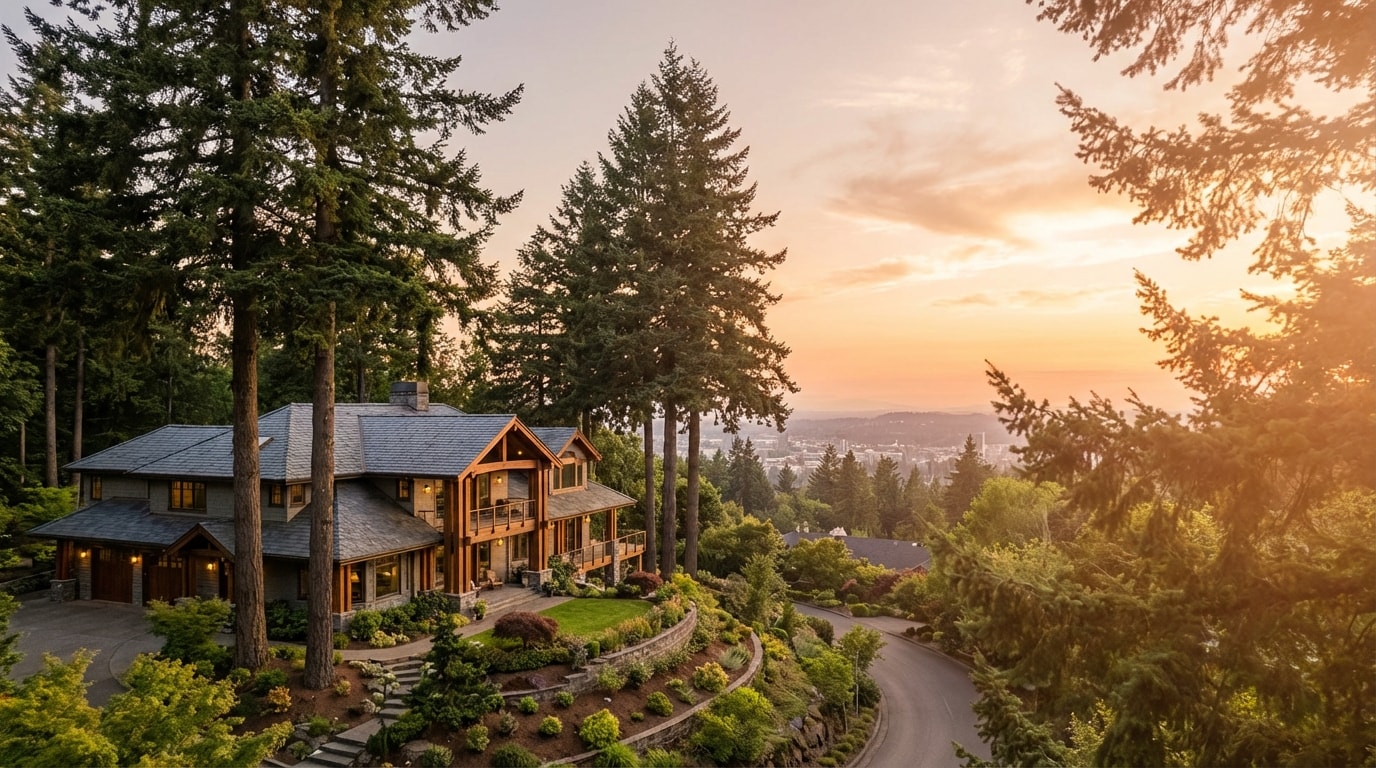
West Hills roofing economics are unlike any other Portland market because of housing complexity and access. The dominant housing stock is the 2,800–4,500 sq ft 1980s–2000s contemporary or modern build on a steep hillside lot, with pitches frequently above 10:12 and rooflines that include multiple gables, hips, valleys, and complex skylight or window-wall intersections. Labor premium runs 25–40% above flat-lot equivalent before any material upgrade is factored in.
Standing seam metal is the dominant West Hills replacement spec, roughly 55% of replacements in this corridor specify metal vs. roughly 15% Portland-wide. Three factors drive the preference: West Hills homeowners run lifecycle economics (50+ year metal life eliminates one or two future asphalt cycles), wind exposure on ridge properties favors concealed-fastener systems that move with thermal expansion rather than asphalt that lifts at high gusts, and metal sheds the heavy moss pressure created by mature canopy on north-facing slopes that would compress asphalt life to 18–22 years here.
Crane access is the access constraint that defines most West Hills projects. Steep hillside lots frequently have driveway access on one side of the home only, with the upper roof area inaccessible from ground-level material staging. Crane day adds $1,400–$3,500 to a project but is meaningfully cheaper than the alternative, manually carrying 24-gauge metal panels or cedar shake bundles up steep slopes adds days of labor and creates fall risk that drives both insurance and OSHA compliance scrutiny.
Wind rating is non-negotiable on ridge properties. Council Crest, Forest Park ridge addresses, and Sylvan-Highlands properties along the SW Patton corridor face sustained 30–50 mph wind events multiple times per year, with occasional 70+ mph peaks during major weather events. The Oregon Residential Specialty Code minimum of 90 mph wind rating is inadequate; 110+ mph is the practical West Hills standard, with concealed-fastener metal systems strongly preferred over exposed-fastener products that strip during high-wind events.
WEST HILLS COST DRIVERS
The factors that move West Hills roofing quotes most, with quantified impact and the explanation behind each. Use these to evaluate whether a contractor's bid reflects local conditions or is missing something.
10:12+ pitches throughout Council Crest, Forest Park, Sylvan-Highlands. Harness systems, slower pace, frequently crane staging required.
Most West Hills projects above 10:12 require crane day for material staging. Cheaper than manual carry up steep slopes.
Dominant West Hills spec. Lifecycle math, wind exposure, and moss elimination favor metal in this corridor.
Ridge-property exposure demands beyond 90 mph code minimum. Concealed-fastener systems strongly preferred.
Multiple gables, hips, valleys, and skylight or window-wall intersections common in 1980s–2000s West Hills builds.
Required above entries, walkways, adjacent driveways. West Hills accumulates more snow load than flat Portland, guards prevent slide events.
WEST HILLS REPLACEMENT BREAKDOWNS
Three representative West Hills replacement projects with line-item breakdowns drawn from typical local housing stock. Use these to anchor what your own quote should look like.
| Tear-off existing architectural asphalt | $3,200 |
| Synthetic high-temp underlayment | $1,200 |
| 24-gauge standing seam panels (matte black) | $19,800 |
| Specialty trim at multiple gables, hips, valleys | $3,200 |
| Snow guard system across south + west slopes | $3,400 |
| Six-nail high-wind attachment (110 mph) | $420 |
| Crane day for upper-roof material staging | $2,400 |
| Steep-pitch fall-protection equipment and labor premium | , |
| Permit + BDS structural review for panel weight | $680 |
| Cleanup and disposal | $680 |
| Total | $34,980 |
Note: Premium West Hills replacement representative of Council Crest contemporary builds. Crane day, snow guards, and wind-rated install together added roughly $7,500 over a flat-lot metal equivalent. Matte black color cleared design review without issue (no historic overlay on this address).
| Tear-off original architectural | $3,400 |
| High-wind synthetic underlayment + ice-and-water at valleys | $1,200 |
| Premium architectural, CertainTeed Presidential | $10,200 |
| Specialty trim at multiple gables, hips, valleys, skylight curbs | $2,800 |
| Six-nail high-wind attachment (110 mph) | $520 |
| Crane day for upper-roof material staging | $1,800 |
| Five skylight curb rebuild + flashing kits | $2,400 |
| Permit + BDS inspection | $520 |
| Cleanup and disposal | $580 |
| Total | $23,420 |
Note: Architectural asphalt replacement on a complex 2001 contemporary. The five skylight curb rebuilds added meaningful cost, original 2001 curbs had aged out before the field shingles. Crane day was unavoidable given driveway access and roof complexity.
| Tear-off existing cedar shake | $3,400 |
| Synthetic underlayment + ice-and-water at eaves | $960 |
| Hand-split cedar shake, #1 grade Western red | $15,400 |
| Copper flashing throughout | $3,800 |
| Pressure-applied fire retardant treatment (Class A target) | $2,400 |
| Six-nail high-wind attachment (Forest Park ridge exposure) | $420 |
| Crane day for steep upper-roof access | $2,200 |
| Permit + BDS inspection | $580 |
| Cleanup and disposal (heavy cedar weight) | $680 |
| Total | $29,840 |
Note: Forest Park ridge cedar retrofit. Class A fire-rated treatment was specifically requested, Forest Park orbit is increasingly seen as wildland-urban interface adjacent, and insurance carriers are starting to require Class A roofing for coverage in this corridor. Hand-split #1 grade is the heritage profile that matches the home's 1985 design intent.
PERMITTING IN WEST HILLS
Portland BDS permit standard. Hillside positioning frequently triggers fall-protection inspection requirements and wind-rating documentation. Crane day permits required on most projects.
- ▸Hillside positioning (10:12+ pitch) triggers fall-protection inspection on installation
- ▸Crane day permits required for limited-access steep-side material staging
- ▸Wind-rating documentation (110+ mph) required for ridge-exposed properties
- ▸Structural review for metal panel weight on retrofit projects (panel weight differs meaningfully from asphalt)
- ▸Forest Park orbit increasingly facing Class A fire rating requirements from insurance carriers
WEST HILLS AT A GLANCE
- ▸Luxury hillside corridor, Council Crest, Forest Park, Sylvan-Highlands, Patton corridor
- ▸Steep pitches (10:12+) and complex contemporary rooflines drive labor premium
- ▸Wind exposure on ridge properties, 110+ mph rating with concealed-fastener systems standard
ROOFING SERVICES IN WEST HILLS
All five services covered by the same West Hills crews. Local cost intelligence on this page applies to every service type, material choice shifts the absolute number, but the West Hills-specific drivers (deck, canopy, permit, design review) apply across the board.
WEST HILLS CATCHMENT
Our West Hills crews also cover these adjacent neighborhoods and surrounding communities. Same pricing, same CCB-licensed work, same local permit knowledge.
- Council Crest
- Forest Park
- Sylvan-Highlands
- Multnomah Village
- Hayhurst
- Hillsdale
- Bridlemile
- Healy Heights
- Patton corridor
WEST HILLS ROOFING QUESTIONS
How much does a roof replacement cost in West Hills?
The average replacement in West Hills (97225) costs $14,800, typically ranging $11k–$26k. Most common material: Standing Seam Metal.
How difficult is it to get a roofing permit in West Hills?
West Hills has a permit difficulty score of 4/5 (Complex). Portland BDS permit standard. Hillside positioning frequently triggers fall-protection inspection requirements and wind-rating documentation. Crane day permits required on most projects.
What roofing contractors serve West Hills?
Multiple licensed Oregon CCB contractors operate in West Hills. Our platform vets all contractors against a 47-point checklist. Use our free quote form to get matched within 48 hours.
Why is metal so dominant in West Hills compared to other Portland neighborhoods?
Three reasons that compound. First, lifecycle economics, West Hills homeowner profile runs the math, and metal's 50+ year life eliminates one or two future replacement cycles in a corridor where steep-pitch labor and crane staging make every replacement expensive. Second, wind exposure on ridge properties, concealed-fastener metal systems flex with thermal expansion and don't strip tabs the way asphalt does at 50+ mph gusts. Third, mature canopy and resulting moss pressure compress asphalt life to 18–22 years here vs. 25+ for metal.
Do I really need crane day for my West Hills project?
Almost always yes for hillside lots above 10:12 pitch with limited driveway access to the upper roof. Crane day adds $1,400–$3,500 to a project but is meaningfully cheaper than the alternative, manually carrying 24-gauge metal panels or cedar shake bundles up steep slopes adds 2–4 days of labor and creates fall risk that triggers OSHA compliance issues. A reputable West Hills contractor will assess access during pre-bid and quote crane requirement explicitly.
What's the right wind rating for my Council Crest home?
110+ mph at minimum, with concealed-fastener metal systems strongly preferred. Council Crest sees sustained 30–50 mph wind events multiple times per year, and the Oregon code minimum of 90 mph is inadequate for ridge exposure. The 110 mph upgrade plus six-nail attachment costs $400–$900 at install. Standing seam metal with concealed fasteners flexes with thermal expansion and shrugs off events that strip tabs from asphalt; exposed-fastener metal products are generally not recommended for ridge exposure.
Are snow guards really required on my West Hills metal roof?
Effectively yes. Standing seam metal sheds snow aggressively, and West Hills accumulates more snow load than the flat Portland metro during winter events. Snow guards above entries, walkways, and adjacent driveways prevent slide events that can cause serious property damage or injury. BDS inspectors flag the absence on metal roofs above pedestrian zones. Cost runs $1,800–$4,200 depending on roof geometry and how much linear coverage is needed. Pad-style guards are most common; rail systems for shallower pitches.
Should I budget for Class A fire rating on my Forest Park ridge property?
Increasingly yes. Forest Park orbit is being re-evaluated as wildland-urban interface adjacent, and insurance carriers in this corridor are starting to require Class A roofing assemblies for coverage independently of city code. Standing seam metal is Class A as standard. Class A architectural asphalt (CertainTeed Landmark Pro Class A, GAF Timberline UHDZ) costs roughly $500–$1,500 over standard architectural. Cedar shake requires pressure-applied fire retardant treatment ($1,500–$2,800) to achieve Class B; Class A on cedar is harder to achieve.