Not a contractor. Lead referral platform covering Portland's 10 deepest cost markets.
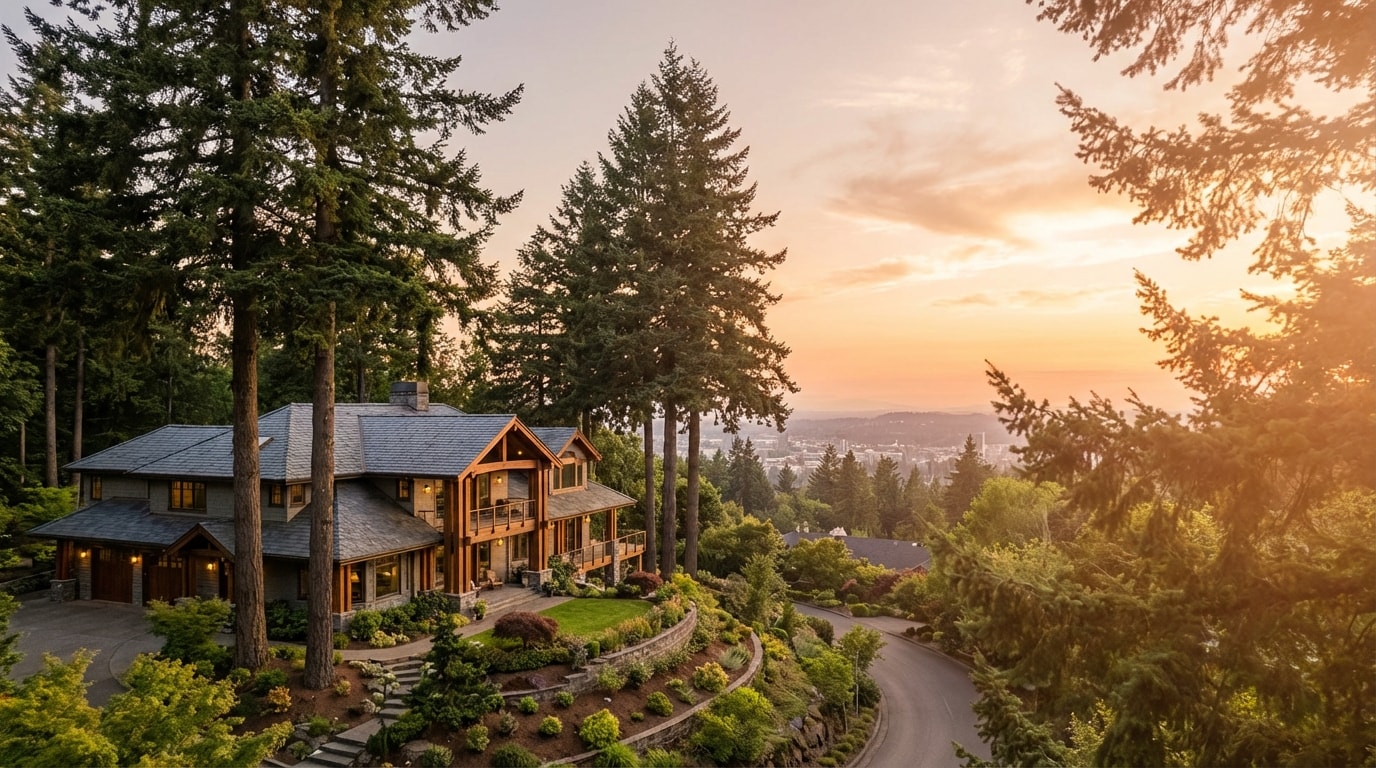
WHAT ROOFING ACTUALLY COSTS IN LAKE OSWEGO
Lake Oswego roofing economics are unlike any other Portland-area suburb. Average cost runs $14,500, roughly 35% above the Portland metro average, driven by three structural factors: housing complexity (steep-pitch hillside homes around the lake demand specialized labor and crane staging), material premium (cedar shake retrofit-in-kind, premium designer asphalt, and standing seam metal dominate the spec mix vs. base architectural elsewhere), and design review overhead (HOA approval is required citywide and adds 2–6 weeks to project timeline before permit issues).
Cedar shake retrofit-in-kind is the signature Lake Oswego replacement project and runs $20,000–$35,000 on a typical Country Club or Lake Forest home. Cedar is mandated by HOA in many of the older subdivisions, performs well in Lake Oswego's relatively benign moisture climate (shaded but not coastal-wet), and is integral to the architectural character of the city. The retrofit involves pressure-applied fire retardant treatment, premium cedar (Western red cedar #1 grade Resawn or hand-split), copper flashing throughout, and ridge ventilation upgrades.
Hillside homes around the lake and on the Mountain Park and Forest Highlands ridges introduce significant labor and access premiums. Pitches of 10:12 to 14:12 are common, requiring harness systems, slower crew pace, and frequently crane staging for material delivery to the steep-side eaves. The labor premium runs 25–40% over flat-lot equivalent. Material consumption is also higher, steeper pitches use more underlayment, more flashing, and more ridge cap per square foot of footprint.
Lake Oswego's permit and design-review process is the most rigorous in the Portland suburbs. Standard re-roof permits run $400–$580 in fees but the binding constraint is design review, material, color, and profile must be approved by either the HOA architectural committee or the city's design review board before the city will issue the building permit. Cedar shake retrofit-in-kind typically clears in 2–3 weeks; standing seam metal in non-traditional colors can take 6–8 weeks; designer asphalt in standard colors clears fastest at 1–2 weeks.
LAKE OSWEGO COST DRIVERS
The factors that move Lake Oswego roofing quotes most, with quantified impact and the explanation behind each. Use these to evaluate whether a contractor's bid reflects local conditions or is missing something.
Country Club, Lake Forest, First Addition HOAs frequently mandate cedar in kind. Premium Western red cedar #1 grade plus copper flashing plus fire retardant treatment.
10:12+ pitches around the lake, Mountain Park, Forest Highlands. Harness systems, slower pace, frequently crane staging required.
Material, color, and profile approval required citywide. Cedar retrofit clears fastest; non-standard metal colors slowest.
Base architectural is rare in Lake Oswego, designer asphalt (CertainTeed Presidential Shake, GAF Glenwood) and standing seam are the spec norms.
Cedar and premium shake projects spec copper flashing throughout (valleys, step, counter, drip edge) for longevity and aesthetic match. Adds meaningfully over standard galvanized.
Lake-edge homes with limited driveway access frequently require crane day for material delivery to upper roof areas.
LAKE OSWEGO REPLACEMENT BREAKDOWNS
Three representative Lake Oswego replacement projects with line-item breakdowns drawn from typical local housing stock. Use these to anchor what your own quote should look like.
| Tear-off existing cedar shake (significant disposal weight) | $3,200 |
| Synthetic high-temp underlayment | $880 |
| Designer architectural, GAF Timberline UHDZ | $8,400 |
| Specialty hip, ridge, valley trim | $1,200 |
| Copper valley flashing | $1,400 |
| Pipe boots and chimney flashing rebuild | $680 |
| HOA design review submittal and approval | $420 |
| Permit + Lake Oswego inspection | $520 |
| Cleanup and disposal | $580 |
| Total | $17,280 |
Note: Cedar-to-architectural conversion roughly $4,000 cheaper than cedar retrofit-in-kind and about $7,000 cheaper than standing seam metal. HOA approval to leave cedar required in this case, many First Addition HOAs are flexible if the replacement looks intentional.
| Tear-off existing cedar shake | $4,200 |
| Synthetic underlayment + ice-and-water at eaves | $1,100 |
| Hand-split cedar shake, #1 grade Western red | $18,400 |
| Copper flashing throughout (valleys, step, counter, drip edge) | $3,200 |
| Pressure-applied fire retardant treatment | $1,800 |
| Ridge ventilation rebuild | $880 |
| Crane day for upper-roof material staging | $1,400 |
| HOA design review + Lake Oswego permit | $680 |
| Cleanup and disposal | $680 |
| Total | $32,340 |
Note: Premium cedar retrofit project. Hand-split #1 grade is the upper tier, Resawn at $14,000–$15,000 would have come in roughly $4,000 cheaper. Copper flashing is non-negotiable for cedar at this tier; galvanized would void HOA approval.
| Tear-off original architectural | $2,400 |
| Synthetic high-temp underlayment | $960 |
| 24-gauge standing seam panels (matte black) | $15,400 |
| Specialty trim at multiple gables, hips, valleys | $2,400 |
| Snow guard system above entry and walkway | $1,400 |
| HOA design review (matte black non-standard color) | $420 |
| Permit + Lake Oswego inspection | $520 |
| Cleanup and disposal | $520 |
| Total | $24,020 |
Note: Mountain Park HOA design review for matte black metal added 6 weeks to project timeline (review board pushed back twice). Final approval came with stipulation that the home's south-facing slope have snow guards visible from the street. Build review timeline into project planning explicitly.
PERMITTING IN LAKE OSWEGO
Lake Oswego permits + design review can extend to 4–8 weeks for cedar restoration or non-standard materials. Strict HOA overlays apply citywide.
- ▸HOA design review required citywide, material, color, and profile approval before permit
- ▸Cedar retrofit-in-kind frequently mandated in older subdivisions (Country Club, Lake Forest, First Addition)
- ▸Copper flashing required on cedar projects in most HOAs; galvanized voids approval
- ▸Snow guard placement on metal roofs frequently dictated by design review board
- ▸Hillside homes (10:12+ pitch) trigger fall-protection inspection and may require crane permit
LAKE OSWEGO AT A GLANCE
- ▸Luxury market, average build $850K+, premium roofing materials standard
- ▸Active HOA design review across most subdivisions, material/color approval required
- ▸Cedar shake heritage in Country Club, Lake Forest, and First Addition neighborhoods
ROOFING SERVICES IN LAKE OSWEGO
All five services covered by the same Lake Oswego crews. Local cost intelligence on this page applies to every service type, material choice shifts the absolute number, but the Lake Oswego-specific drivers (deck, canopy, permit, design review) apply across the board.
LAKE OSWEGO CATCHMENT
Our Lake Oswego crews also cover these adjacent neighborhoods and surrounding communities. Same pricing, same CCB-licensed work, same local permit knowledge.
- Lake Grove
- First Addition
- Westlake
- Mountain Park
- Marylhurst
- Palisades
- Forest Highlands
- Skylands
- Country Club
- Lake Forest
- West Linn
- Oregon City
- Stafford
- Bolton
LAKE OSWEGO ROOFING QUESTIONS
How much does a roof replacement cost in Lake Oswego?
The average replacement in Lake Oswego (97034) costs $14,500, typically ranging $10k–$22k. Most common material: Cedar Shake.
How difficult is it to get a roofing permit in Lake Oswego?
Lake Oswego has a permit difficulty score of 5/5 (Maximum). Lake Oswego permits + design review can extend to 4–8 weeks for cedar restoration or non-standard materials. Strict HOA overlays apply citywide.
What roofing contractors serve Lake Oswego?
Multiple licensed Oregon CCB contractors operate in Lake Oswego. Our platform vets all contractors against a 47-point checklist. Use our free quote form to get matched within 48 hours.
Why is Lake Oswego so much more expensive than the Portland metro average?
Three structural factors. First, housing complexity, steep-pitch hillside homes around the lake demand specialized labor and frequently crane staging, adding 25–40% to labor cost. Second, material premium, base architectural asphalt is rare here; the spec norms are designer asphalt, cedar shake retrofit-in-kind, or standing seam metal. Third, design review overhead, HOA approval citywide adds 2–6 weeks before permit issues, and cedar/copper requirements in many subdivisions are non-negotiable.
Can I replace my Country Club cedar shake with architectural asphalt?
Sometimes, but you'll need explicit HOA approval first, and many Country Club / Lake Forest sub-associations don't grant it. Cedar shake is integral to the architectural character of these neighborhoods, and HOAs frequently require retrofit-in-kind or designer asphalt that mimics the cedar profile. Submit your proposed alternative with formal documentation; expect 4–6 weeks of review. If denied, your real options are cedar retrofit-in-kind ($20,000–$35,000) or designer shake-profile asphalt like CertainTeed Presidential Shake ($14,000–$18,000).
What's the lifecycle cost difference between cedar retrofit and standing seam metal?
Cedar: $25,000–$35,000 install plus $300–$600 annual cleaning and biannual moss treatment plus fire retardant renewal every 7 years ($2,000+). Real-world life of 25–35 years with maintenance, less without. Standing seam metal: $20,000–$28,000 install with effectively zero maintenance for 50+ years. Over 50 years, metal wins decisively on lifecycle cost. The case for cedar is architectural character, HOA mandate, and aesthetic match to the home, not lifecycle economics.
How long does Lake Oswego's design review actually take?
Highly variable by material and color. Cedar retrofit-in-kind typically clears in 2–3 weeks. Designer asphalt in standard colors approved in subdivision palette: 1–2 weeks. Standing seam metal in standard charcoal/slate: 3–4 weeks. Standing seam metal in non-standard colors (matte black, weathered copper): 6–8 weeks with frequent revisions. Build the review timeline into project planning explicitly, starting work without final approval is the fastest way to draw a stop-work order from the city.
Are copper flashings really required on cedar projects?
Required by HOA in most Country Club / Lake Forest / First Addition sub-associations, even where not explicitly required by code. Copper is the architectural match to cedar's heritage character and outlasts galvanized by 30+ years. Cost premium is $1,500–$4,000 for full copper flashing (valleys, step, counter, drip edge) over galvanized equivalent. Most contractors who specialize in Lake Oswego cedar work include copper as standard rather than treating it as an upgrade.
Do I need crane day for my Mountain Park or Forest Highlands hillside home?
Often yes for hillside lots above 10:12 pitch where the upper roof areas can't be accessed from the driveway. Crane staging adds $1,000–$2,500 to a project but is meaningfully cheaper than the alternative, manually carrying cedar shake bundles or 24-gauge metal panels up steep slopes adds days of labor and creates fall risk. A reputable Lake Oswego contractor will assess access during pre-bid and quote crane requirement explicitly.