Not a contractor. Lead referral platform covering Portland's 10 deepest cost markets.
WHAT ROOFING ACTUALLY COSTS IN EASTMORELAND
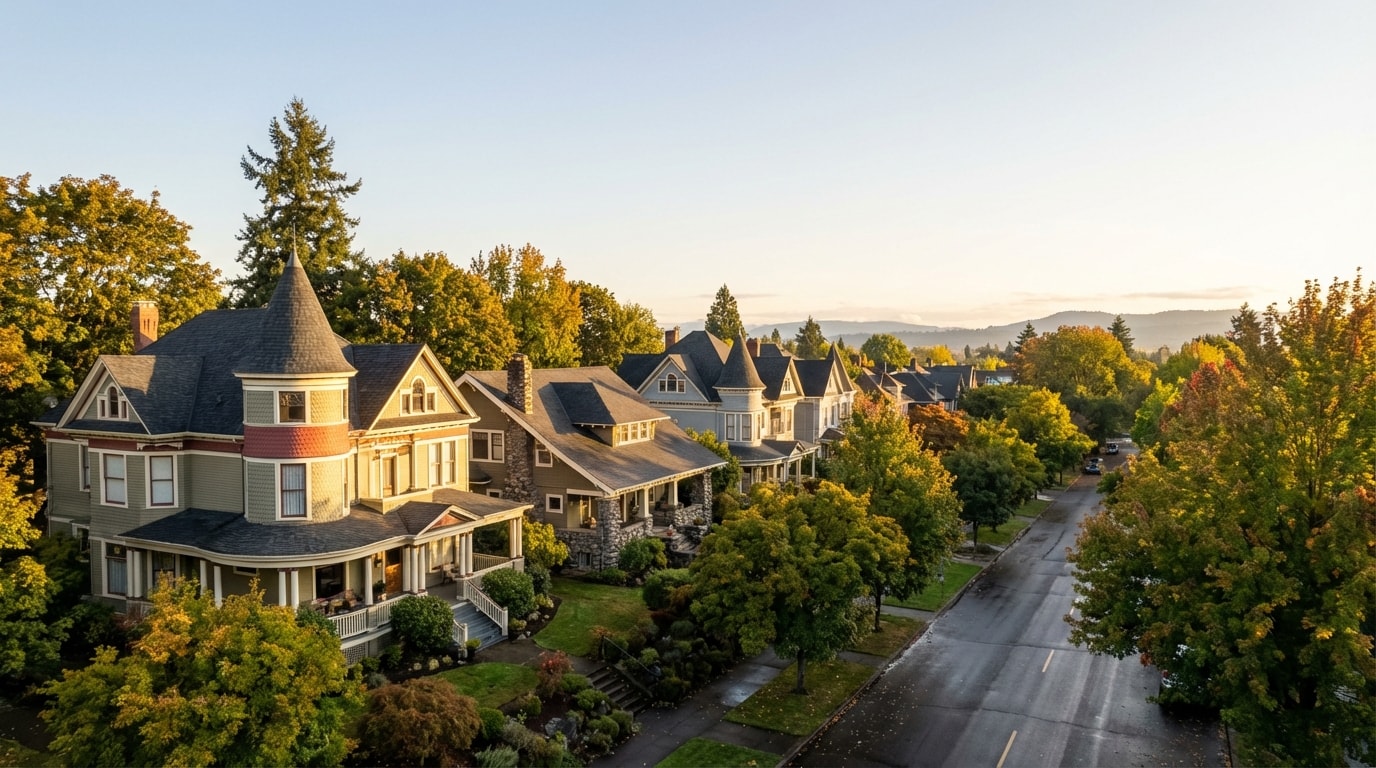
Eastmoreland is Portland's premier historic district outside the Central City overlay, and the roofing economics reflect that. The dominant housing stock is the 2,000–3,500 sq ft 1920s–1940s Tudor, Craftsman, or Colonial Revival home on a generous lot with mature canopy. Many of these homes are on their second or third roof since original construction, and historic district design review binds the material and profile decisions in a way no other Portland neighborhood enforces.
Cedar shake is the heritage material in Eastmoreland and remains the dominant spec. The Eastmoreland Historic District design review board approves cedar retrofit in kind with relative speed (3–4 weeks) and limited material substitution. Cedar conversion to architectural asphalt is possible but requires Type II Historic Resource Review with formal documentation; conversion to standing seam metal triggers additional scrutiny. The practical effect is that cedar replacement is the path of least resistance for most Eastmoreland homeowners, and accordingly the most common project type.
The premium tier of Eastmoreland projects ($18,000–$25,000) involves cedar shake retrofit with hand-split #1 grade Western red cedar, copper flashing throughout, pressure-applied fire retardant treatment, and complex roofline detail work on multi-gable Tudor or Colonial Revival properties. Smaller mid-tier homes ($12,000–$16,000) typically use Resawn cedar with galvanized flashing acceptable to design review. Conversion projects to architectural asphalt land at $14,000–$18,000 inclusive of review fees and timeline.
Reed College orbit creates an unusually stable Eastmoreland homeowner profile, long holds (15+ years average), professional homeowners who run lifecycle cost analysis, and an active neighborhood association that pays attention to roofing projects across the district. The combination drives demand toward cedar retrofit and standing seam metal upgrades over the cheaper architectural asphalt path that dominates other Portland neighborhoods. Premium projects are normal here, not exceptional.
EASTMORELAND COST DRIVERS
The factors that move Eastmoreland roofing quotes most, with quantified impact and the explanation behind each. Use these to evaluate whether a contractor's bid reflects local conditions or is missing something.
Eastmoreland Historic District design review favors cedar in kind. Hand-split Western red cedar plus copper flashing plus fire retardant treatment is the premium tier.
Cedar in kind clears fastest. Material substitution (asphalt or metal) triggers Type II Historic Resource Review with longer timeline and material binding.
Hand-split offers the heritage profile design review favors on landmark properties. Resawn is acceptable on most Eastmoreland projects and costs meaningfully less.
Copper is the architectural match for cedar's heritage character and design review favored on most landmark properties. Galvanized acceptable on standard properties.
Larger Eastmoreland Tudors and Colonial Revivals have multi-gable rooflines with significant valley intersection complexity vs. simpler bungalow geometry.
Required on cedar shake projects to achieve Class B fire rating. Treatment lasts 7–10 years before renewal needed.
EASTMORELAND REPLACEMENT BREAKDOWNS
Three representative Eastmoreland replacement projects with line-item breakdowns drawn from typical local housing stock. Use these to anchor what your own quote should look like.
| Tear-off existing cedar shake (significant disposal weight) | $3,400 |
| Synthetic underlayment + ice-and-water at eaves | $880 |
| Hand-split cedar shake, #1 grade Western red | $13,800 |
| Copper flashing throughout (design review requirement) | $3,200 |
| Pressure-applied fire retardant treatment | $1,600 |
| Multi-gable trim and valley detail | $2,400 |
| Ridge ventilation rebuild | $880 |
| Eastmoreland Historic District design review submission | $420 |
| Permit + BDS inspection | $520 |
| Cleanup and disposal | $580 |
| Total | $27,700 |
Note: Premium Eastmoreland Tudor retrofit. Hand-split #1 grade and copper flashing both reflect design review preference for landmark properties. Resawn cedar with galvanized flashing would have come in roughly $5,500 cheaper but design review pushed back on the initial Resawn proposal, the home is contributing to the historic district character and reviewers wanted heritage material profile.
| Tear-off existing cedar shake | $2,400 |
| Synthetic high-temp underlayment | $760 |
| 24-gauge standing seam panels (heritage charcoal) | $13,400 |
| Specialty ridge, hip, valley, gable trim | $2,200 |
| Snow guard system above entries (design review requirement) | $1,200 |
| Type II Historic Resource Review (cedar conversion) | $680 |
| Eastmoreland design review submission and approval | $580 |
| Permit + BDS inspection | $520 |
| Cleanup and disposal | $420 |
| Total | $22,160 |
Note: Cedar-to-metal conversion required Type II Historic Resource Review and Eastmoreland design review running in parallel. Total review timeline was 9 weeks (longer than the 4–6 typical for cedar in kind). Snow guards above entries were specifically requested by design review as a heritage character detail. Final approval came with stipulation that future maintenance would be reviewed if material profile or color changes.
| Tear-off existing cedar shake (heavy disposal) | $4,200 |
| Synthetic underlayment + ice-and-water at eaves and valleys | $1,200 |
| Hand-split cedar shake, #1 grade Western red | $17,800 |
| Copper flashing throughout | $4,400 |
| Pressure-applied fire retardant treatment | $2,200 |
| Complex multi-gable Colonial Revival trim and detail work | $3,800 |
| Ridge ventilation rebuild + soffit upgrade | $1,400 |
| Eastmoreland Historic District design review | $520 |
| Permit + BDS inspection | $680 |
| Cleanup, disposal, premium-property cleanup standards | $880 |
| Total | $37,080 |
Note: Premium upper-tier Eastmoreland project. The Colonial Revival multi-gable roofline added roughly $4,000 in trim and detail labor over a simpler Tudor equivalent. Hand-split #1 grade and copper throughout are standard for landmark properties, design review pushes back on cost-saving substitutions on contributing properties.
PERMITTING IN EASTMORELAND
Eastmoreland Historic District design review applies to all visible roofing changes. Cedar shake retrofit in kind clears fastest; any material change requires Type II Historic Resource Review with material/color binding.
- ▸Eastmoreland Historic District design review applies to all visible roofing changes
- ▸Cedar shake retrofit in kind is the path of least resistance, fastest review timeline
- ▸Material substitution (cedar to asphalt or metal) requires Type II Historic Resource Review with formal documentation
- ▸Hand-split cedar and copper flashing favored on landmark properties (contributing structures)
- ▸Pressure-applied fire retardant treatment required on cedar shake projects for Class B rating
EASTMORELAND AT A GLANCE
- ▸Eastmoreland Historic District, one of Portland's strictest design review overlays
- ▸Large 1920s–1940s Tudor and Craftsman estates with cedar shake heritage
- ▸Reed College orbit creates stable owner-occupied market with long holds
ROOFING SERVICES IN EASTMORELAND
All five services covered by the same Eastmoreland crews. Local cost intelligence on this page applies to every service type, material choice shifts the absolute number, but the Eastmoreland-specific drivers (deck, canopy, permit, design review) apply across the board.
EASTMORELAND CATCHMENT
Our Eastmoreland crews also cover these adjacent neighborhoods and surrounding communities. Same pricing, same CCB-licensed work, same local permit knowledge.
- Reed College area
- Eastmoreland Golf Course
- Crystal Springs
- Berkeley
- Woodstock (north edge)
- Sellwood (south border)
- SE Bybee corridor
EASTMORELAND ROOFING QUESTIONS
How much does a roof replacement cost in Eastmoreland?
The average replacement in Eastmoreland (97202) costs $13,800, typically ranging $10k–$22k. Most common material: Cedar Shake.
How difficult is it to get a roofing permit in Eastmoreland?
Eastmoreland has a permit difficulty score of 5/5 (Maximum). Eastmoreland Historic District design review applies to all visible roofing changes. Cedar shake retrofit in kind clears fastest; any material change requires Type II Historic Resource Review with material/color binding.
What roofing contractors serve Eastmoreland?
Multiple licensed Oregon CCB contractors operate in Eastmoreland. Our platform vets all contractors against a 47-point checklist. Use our free quote form to get matched within 48 hours.
Can I really not replace my Eastmoreland cedar with architectural asphalt?
You can, but it requires Type II Historic Resource Review with formal documentation explaining the substitution. Eastmoreland Historic District design review favors cedar in kind and pushes back on material substitutions on contributing properties. Conversion approval is more likely on non-contributing properties (post-1965 builds) and on properties with previous non-cedar roofing already approved. Submit a formal proposal early, the review can take 4–6 weeks and the outcome binds the material decision.
Hand-split versus Resawn cedar, which does Eastmoreland design review require?
Hand-split Western red cedar is favored on contributing landmark properties and is sometimes specifically required by design review on properties that anchor the district character. Resawn cedar is acceptable on most properties and costs roughly $4,000–$6,000 less than hand-split #1 grade. Submit your proposed material profile during design review and accept that the board may push back to hand-split on landmark properties. The final material decision is bound by review approval, not contractor preference.
How long does the full Eastmoreland design review process actually take?
Cedar in kind clears fastest at 3–4 weeks. Material substitution (cedar to architectural asphalt or metal) requires Type II Historic Resource Review running in parallel and typically takes 4–6 weeks. Non-standard color or profile choices on metal can extend to 6–9 weeks with multiple revision cycles. Build the review timeline into project planning explicitly, starting installation work without final approval triggers a stop-work order from BDS.
Why is copper flashing pushed by Eastmoreland design review?
Copper is the architectural match for cedar's heritage character and is favored by design review on contributing properties. Copper flashing also outlasts galvanized by 30+ years, which matters on a heritage cedar project where the flashing may be expected to outlive multiple cedar replacement cycles. Copper premium over galvanized runs $2,000–$4,500 on a typical Eastmoreland project. On non-contributing properties, galvanized is usually acceptable.
Should I budget for the pressure-applied fire retardant treatment?
Yes if you're going with cedar shake. The treatment is required to achieve Class B fire rating that most Eastmoreland properties need for insurance compliance, and it's expected by design review as part of a complete cedar shake project. Cost runs $1,200–$2,400 depending on roof size. The treatment lasts 7–10 years before renewal is needed (renewal is roughly 60% of original treatment cost).