Not a contractor. Lead referral platform covering Portland's 10 deepest cost markets.
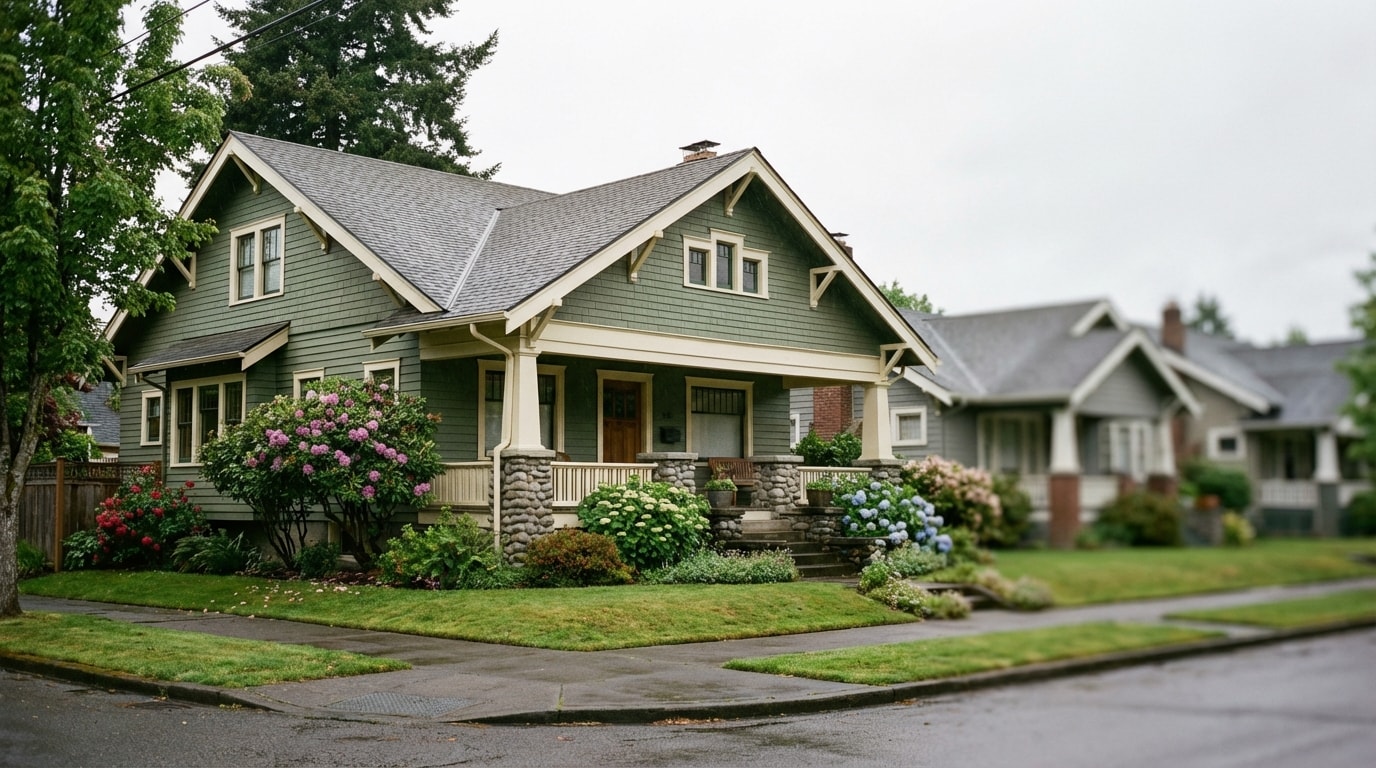
WHAT ROOFING ACTUALLY COSTS IN HAWTHORNE
Hawthorne is the highest-volume residential re-roofing market in Portland, and the per-job cost spread reflects the variable that dominates Inner SE: deck condition. The 1900–1925 housing stock that defines this neighborhood was built with skip-sheathed decking, 1×4 boards with gaps that were code-compliant for cedar shake but require full plywood overlay before modern asphalt shingles can be installed. That overlay adds $2,500–$5,000 to a project, and a contractor who hasn't accounted for it pre-bid is setting up a change order.
The dominant Hawthorne housing stock is the 1,400–2,000 sq ft Craftsman bungalow with a single-story footprint, modest hip or gable roofline, and original cedar deck planks that have aged well or poorly depending on the slope and tree canopy exposure. Sound decks re-roof at $8,500–$12,000 with architectural asphalt; decks needing significant overlay or repair run $13,000–$18,000. The variable that determines which bucket a specific property falls into isn't visible until tear-off begins.
Tree canopy is the second-largest cost driver and the one most Hawthorne homeowners underestimate. The residential streets between SE 30th and SE 50th, particularly south of Hawthorne Boulevard, sit under significant Douglas fir, big-leaf maple, and oak cover. That canopy creates heavy moss pressure on shaded shed lines and accelerates granule loss on north-facing slopes. Homes in heavy-canopy locations should expect to budget for biennial moss treatment ($300–$600 per cycle) and zinc ridge strip installation ($150–$400 one-time) as part of any new roof.
Historic district considerations apply to a meaningful share of Hawthorne properties. Ladd's Addition borders the western edge and triggers Type II Historic Resource Review for any visible material change. Several individual properties are on Portland's Historic Resource Inventory and require similar review. Confirm at portlandmaps.com before signing a contract, a Type II review adds 4–6 weeks to project timeline and binds material and color choices.
HAWTHORNE COST DRIVERS
The factors that move Hawthorne roofing quotes most, with quantified impact and the explanation behind each. Use these to evaluate whether a contractor's bid reflects local conditions or is missing something.
Almost universal on Hawthorne Craftsmans and foursquares. Per-sheet plywood overlay rate should be specified in contract before signing.
Streets between SE 30th and SE 50th sit under heavy canopy. Zinc ridge strip plus biennial chemical treatment is the difference between 18 and 28 years of asphalt life.
Properties bordering Ladd's or individually listed face Type II Historic Resource Review. Material and color become binding rather than discretionary.
On homes that already had cedar replaced once before, deck condition is variable. Per-sheet replacement rate is essential pre-bid spec.
Foursquare housing stock (more common on numbered streets between SE 20th and SE 40th) requires more scaffolding and slower install pace than single-story bungalows.
HAWTHORNE REPLACEMENT BREAKDOWNS
Three representative Hawthorne replacement projects with line-item breakdowns drawn from typical local housing stock. Use these to anchor what your own quote should look like.
| Tear-off and disposal (existing 3-tab over original cedar) | $2,200 |
| Plywood overlay over skip-sheathed deck (24 sheets) | $2,640 |
| Ice-and-water shield (eaves, valleys, around chimney) | $680 |
| Synthetic underlayment over field | $440 |
| Architectural shingles, GAF Timberline HDZ, AR granules | $5,400 |
| Ridge vent installation + soffit baffle upgrade | $720 |
| Step + counter flashing rebuild at chimney | $580 |
| Zinc ridge strip moss prevention | $280 |
| Permit + BDS inspection | $320 |
| Cleanup, dump fees, magnetic sweep | $380 |
| Total | $13,640 |
Note: Solid Hawthorne replacement. Two-layer tear-off (original cedar plus 1990s asphalt re-roof), full deck overlay, and ventilation upgrade are standard for 1912 stock. Adding zinc ridge strip at install is the cleanest cost-effective add for any Hawthorne home with mature tree canopy, $280 buys 3–5 years of additional roof life through deferred moss colonization.
| Tear-off existing single layer | $1,800 |
| Deck spot repair (5 sheets) | $650 |
| Synthetic underlayment + ice-and-water at eaves | $540 |
| Architectural shingles, CertainTeed Landmark Pro | $5,800 |
| Ridge vent + soffit baffle upgrade | $680 |
| Two-story labor premium | , |
| Pipe boots and step flashing | $420 |
| Permit + BDS inspection | $320 |
| Cleanup and disposal | $380 |
| Total | $10,590 |
Note: Foursquare came in lower than the bungalow despite being slightly larger because the deck was sound (homeowner had previous re-roof in 2002 with deck overlay already done). Two-story labor is built into the per-sq pricing of established Hawthorne contractors.
| Tear-off existing cedar shake (significant disposal weight) | $2,800 |
| Synthetic underlayment + ice-and-water at eaves | $680 |
| Hand-split cedar shake, #1 grade Western red | $11,200 |
| Copper flashing throughout (HRC requirement) | $2,400 |
| Pressure-applied fire retardant treatment | $1,400 |
| Ridge ventilation rebuild | $680 |
| Type II Historic Resource Review submission | $580 |
| Permit + BDS Inspection | $420 |
| Cleanup, disposal (heavy cedar weight) | $520 |
| Total | $20,680 |
Note: Premium retrofit on a property where Type II Historic Resource Review bound the material to cedar in kind. Hand-split #1 grade Western red is the upper tier; Resawn at $7,800 would have come in roughly $3,400 cheaper. Copper flashing was non-negotiable per HRC review, galvanized would have voided approval.
PERMITTING IN HAWTHORNE
Standard Portland BDS permit applies. Properties on the Historic Resource Inventory or in adjacent listed districts (Ladd's Addition borders to the west) face additional design review. Most central Hawthorne re-roofs clear permit in 5–7 business days online.
- ▸Properties bordering Ladd's Addition (west of SE 16th) face Type II Historic Resource Review on visible material changes
- ▸Individual properties on Portland's Historic Resource Inventory require similar review regardless of neighborhood location
- ▸Re-roofing over an existing layer typically not permitted, full tear-off required
- ▸Attic ventilation ratio (1:300 balanced) actively reviewed at final inspection
HAWTHORNE AT A GLANCE
- ▸Inner SE Craftsman/foursquare core, 1900–1925 housing stock dominant
- ▸Highest residential roofing search volume of any Portland neighborhood
- ▸Tree canopy on residential streets creates significant moss pressure on shaded slopes
ROOFING SERVICES IN HAWTHORNE
All five services covered by the same Hawthorne crews. Local cost intelligence on this page applies to every service type, material choice shifts the absolute number, but the Hawthorne-specific drivers (deck, canopy, permit, design review) apply across the board.
HAWTHORNE CATCHMENT
Our Hawthorne crews also cover these adjacent neighborhoods and surrounding communities. Same pricing, same CCB-licensed work, same local permit knowledge.
- Belmont
- Buckman
- Kerns
- Sunnyside
- Richmond
- Division-Clinton
- Ladd's Addition (border)
- Mt Tabor (lower)
HAWTHORNE ROOFING QUESTIONS
How much does a roof replacement cost in Hawthorne?
The average replacement in Hawthorne (97214) costs $9,800, typically ranging $7.5k–$15k. Most common material: Architectural Asphalt.
How difficult is it to get a roofing permit in Hawthorne?
Hawthorne has a permit difficulty score of 3/5 (Moderate). Standard Portland BDS permit applies. Properties on the Historic Resource Inventory or in adjacent listed districts (Ladd's Addition borders to the west) face additional design review. Most central Hawthorne re-roofs clear permit in 5–7 business days online.
What roofing contractors serve Hawthorne?
Multiple licensed Oregon CCB contractors operate in Hawthorne. Our platform vets all contractors against a 47-point checklist. Use our free quote form to get matched within 48 hours.
Is my Hawthorne home in a historic district?
Most central Hawthorne residential addresses are not in a listed historic district, but properties bordering Ladd's Addition (west of SE 16th between Hawthorne and SE Division) and individual properties on Portland's Historic Resource Inventory face Type II Historic Resource Review. Confirm at portlandmaps.com using your property address, the review status binds material and color choices and adds 4–6 weeks to project timeline.
How much should I budget for skip-sheathed deck overlay?
On a typical 1,650–2,000 sq ft Hawthorne Craftsman or foursquare, plan for $2,500–$4,500 in plywood overlay material and labor. Per-sheet rate runs $90–$140 installed. The overlay is required because pre-1925 skip-sheathed decking (1×4 boards with gaps) cannot support modern asphalt shingle attachment patterns. Get the per-sheet rate in writing before signing, quotes that don't include deck overlay are either incomplete or assume a deck condition the contractor hasn't actually verified.
Should I install zinc ridge strip if I'm re-roofing in Hawthorne?
Almost always yes if you have any tree canopy on or adjacent to the property. Zinc ridge strip releases trace zinc with each rain event and suppresses moss across the entire downslope for 15–20 years. Cost at install is $150–$400. Without it, plan on biennial chemical moss treatment at $300–$600 per cycle starting around year 4 of the new roof. The zinc strip is the single most cost-effective preventive measure available on Hawthorne residential roofs.
Why is Hawthorne's contractor pool so much larger than other Portland neighborhoods?
Hawthorne is the highest-volume residential re-roofing market in Portland because of its housing density, the predominance of pre-1925 stock that's now in active replacement cycles, and tree canopy that compresses real-world asphalt life. Established Portland roofing companies routinely have 6–10 active Hawthorne projects in any peak season. Practical impact: bid spreads on standard scope are tighter than anywhere outside the Pearl, and three-bid comparisons are reliable. The trade-off is fly-by-night operators are more numerous in a dense market, CCB licensing verification matters more here.
How does Inner SE wind exposure affect my Hawthorne roof spec?
Less than the West Hills or East Wind corridor neighborhoods, but meaningful. Standard 90 mph wind rating is the Oregon code minimum and is technically adequate for most Hawthorne addresses. The 110 mph upgrade plus six-nail attachment costs $200–$500 at install and is a reasonable Hawthorne standard for any home that catches direct east-wind exposure. Properties on the eastern edge (SE 50th and beyond) benefit most from the upgrade.